Series The Harness · 1 of 5
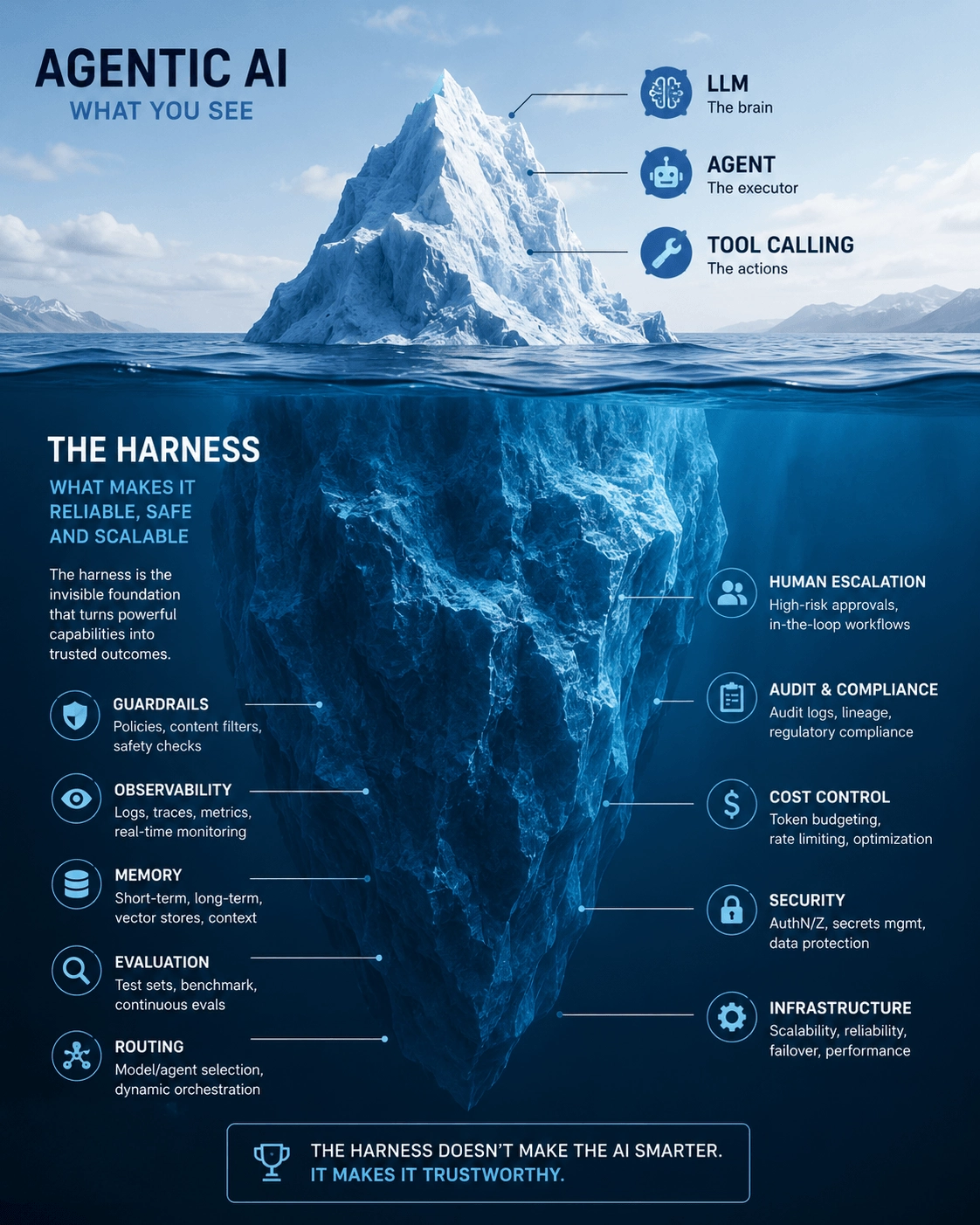
There is a common comparison in the AI debate, the model is the brain. It is not wrong. It is also incomplete, in a way that costs millions every quarter.
The thing that holds the brain, gives it tools, decides what it can do and when it stops, is called the harness. The industry mentions it almost in a whisper. This series puts it at the center, where it belongs.
Same brain, different body
In February 2026 a research team ran 731 problems through three different agent frameworks, the same Opus 4.5 model under each. The scores landed 17 issues apart, enough to reshuffle the leaderboard. An independent test by Matt Mayer ran the same Claude Opus inside Claude Code and inside Cursor. Same weights, two different harnesses. Claude Code scored 77%. Cursor scored 93%. Sixteen points of apparent capability, with the brain held constant.
Whatever you think the model is doing, half of it is the harness doing it for the model.
What is in the body
The word stays vague on purpose, and the next post in this series is about why. Here, briefly: a harness is the scaffolding around the model. It manages the context window, deciding what the model sees and what gets summarized or dropped. It exposes a specific set of tools and a specific calling format, and it catches the errors when those tools fail. It feeds the model the output of its own previous failed attempts, so the next try is informed instead of repeating the loop. It enforces an iteration budget, deciding how many edit-test cycles the model gets before the task is marked failed.
The same study found that a smarter feedback loop on failed attempts produces 5 to 10 points of apparent model improvement with no change to the weights. None of that lives in the brain. All of it lives in the body.
The procurement mistake
In enterprise procurement the conversation is almost always about the brain. Which model. GPT-5 or Opus 4.5 or Gemini 3. The board signs off. Six months later the agent does not walk, and the team blames the model.
Buy the brain. Get surprised it does not walk.
That is the pattern, and it is structural. The model is now a near-commodity, the major labs hover within a few points of each other on most benchmarks. The brain is more or less decided the day you choose a vendor. What determines outcome is what you put around it, and almost nobody at the procurement table is qualified to ask the right questions about the body.
So when you next evaluate an agentic deployment, do not ask which model it uses. Ask whose harness it sits in, what that harness does when something breaks, and how many points of the demo score belong to the body, not to the brain.
— Pan
Part of The Harness, a series on the centrality of the harness in agentic AI. Next: the model is the commodity, the harness is the moat.