Series The Harness · 2 of 5
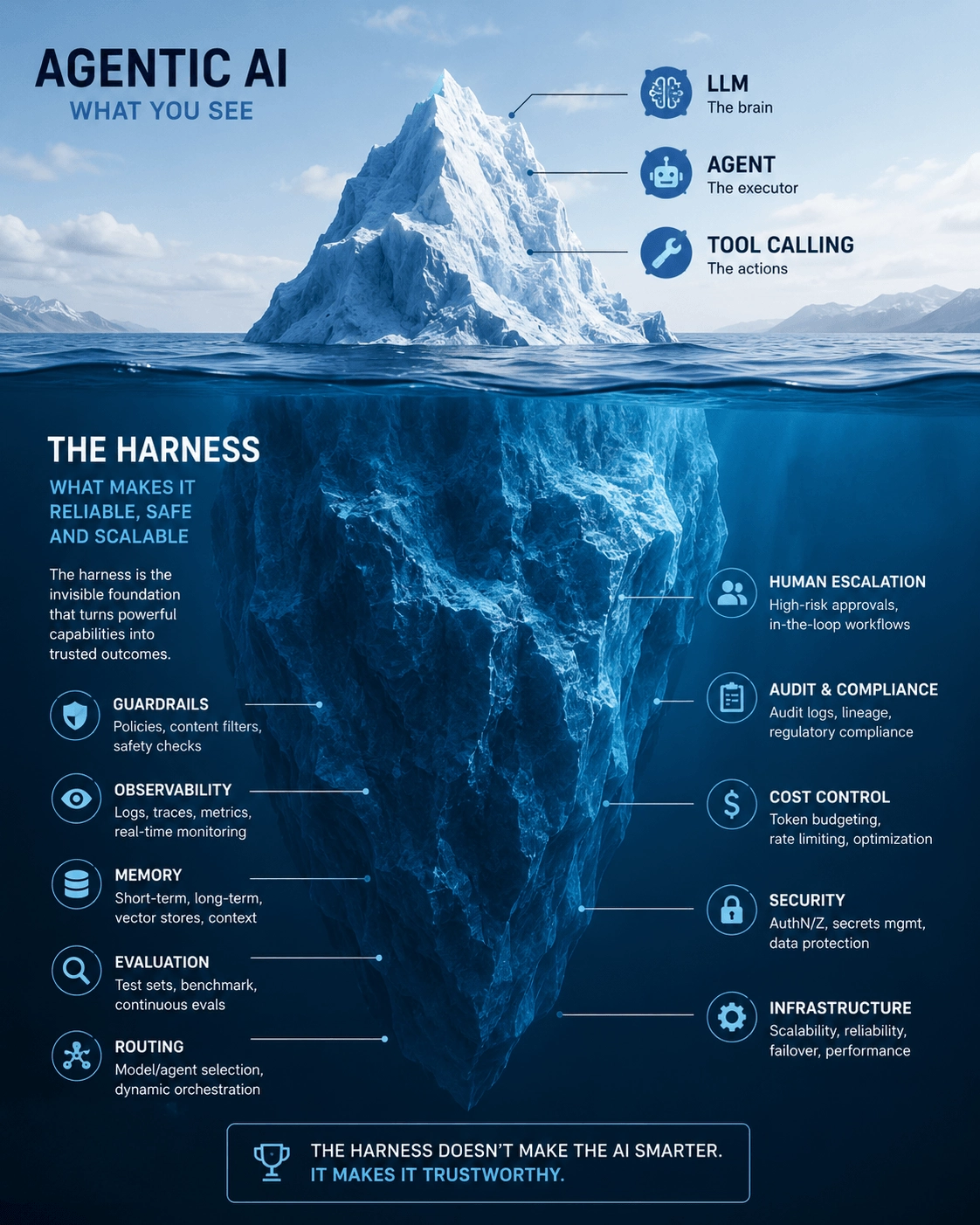
Cognition raised $1 billion at a $26 billion valuation in June 2026. Their product, Devin, went from $37 million in ARR a year ago to $492 million today. A 1,230% jump in twelve months.
Cognition does not train a frontier model. Its $26 billion sits, in the words of the analysts who priced the round, on harness design, agent orchestration, and the workflow that wraps the model.
That is the moat thesis, fully priced.
What the market is paying for
Look at the two companies the agentic AI market is paying hardest for. Cognition, $26B, has built Devin on top of frontier models from OpenAI, Anthropic, and others. Cursor sits at $29B, $2B in ARR, with SpaceX reportedly holding an option to acquire it outright at $60B. Neither company runs its own foundation model. Both are pure harness.
What the public market and the VCs are actually buying is not the brain. It is the body around it.
The model, meanwhile, converges
GPT-5, Claude Opus 5, Gemini 3, Llama 4 hover within a few points of each other on almost every benchmark that anyone cites. The gap between the top model and the third-best model used to be 10 to 15 points. It is now closer to 3. The graph of model-to-model differences is going flat.
The graph of harness-to-harness differences keeps going up. The same Opus 4.5 in Claude Code and in Cursor sits 16 points apart on real workloads, as covered in the first post in this series. The model is converging, the harness is diverging. That is a moat moving from one place to another in real time, and most boards are still looking at the place where it used to be.
Why the harness compounds
A model is sold to everyone, on the same day, at roughly the same price. There is no defensibility in being a customer of Anthropic. The harness is different, it compounds in four ways.
Proprietary evals get richer with every deployment, because every customer's failure modes feed back into the test suite. Tool ecosystems get sticky with integration debt, because the customer's internal systems get plumbed into the harness's tool layer and stay there. Per-session memory becomes irreplaceable for power users, because the harness remembers their preferences and their codebase. And the brand of the loop, Claude Code, Cursor, Devin, becomes shorthand for trust, which is the only form of defensibility that cannot be replicated by spending more on inference.
The model can be swapped in a weekend. The harness takes years to replace.
What boards keep missing
In procurement the conversation is still "which model are you using". The honest answer is that it does not really matter. They all pass the same benchmarks within a few points. Which harness, who built it, what it learns from your data, what it locks you into, are the questions that decide defensibility.
The brain is sold to everyone. The moat is what you wrap around it.
Asking a startup which foundation model it uses, and treating the answer as a strategic differentiator, is asking a restaurant which oven brand it owns and treating the answer as cuisine.
— Pan
Part of The Harness, a series on the centrality of the harness in agentic AI. Previous: the model is the brain, the harness is the body. Next: Claude Code works because of the cage.